
Land Biodiversity Footprints (LBF)
Whether for agriculture, mining, or infrastructure, land is often one of a company’s most important assets. However, land use impacts on nature can translate into material risks, especially where activities intersect with sensitive ecosystems. At the same time, high land use footprints often reveal opportunities for stewardship - such as improved land management, supplier engagement, restoration, and landscape level collaboration - that can reduce risk, create long term value, and support nature positive strategies.
The Land Biodiversity Footprint (LBF) methodology enables large-scale assessments of the biodiversity impacts and opportunities of land use. It is designed to help companies understand how their direct operations and upstream value chains impact biodiversity through land occupation, using a transparent and spatially explicit approach.
Land Biodiversity Footprints are built on the Extent, Condition and Significance framework:
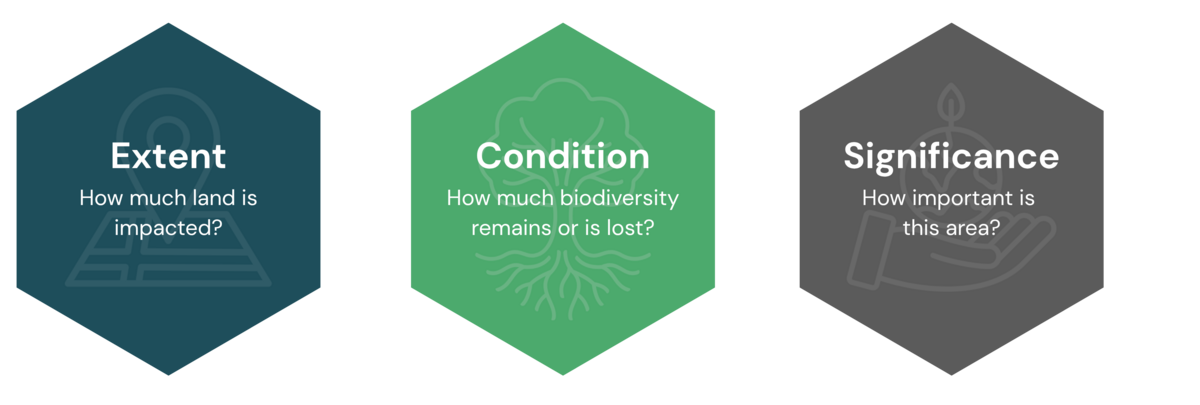
LBF assessments explicitly capture both existing impacts (the ecological opportunity cost of occupying land) and optionally new impacts (from land‑use change and conversion). By breaking impacts down into transparent steps — how much land is used, how altered it is, and how important it is for biodiversity, LBF enables companies to understand why impacts occur, where they matter most, and what levers exist to avoid, reduce, or reverse them.
The methodology is flexible by design. It can be used with global models and sector averages for initial estimates, or combined with detailed, site‑specific data to support fine‑grained decision‑making, scenario testing and target‑setting.
How LBF works
Understanding land‑use impacts in depth
LBF is purpose‑built for in‑depth assessment of biodiversity impacts linked to land occupation. It is particularly well suited to agriculture, forestry, mining, and other land‑intensive sectors, where land use is the dominant driver of biodiversity loss. The framework quantifies both the scale of land use and the resulting biodiversity loss, providing a robust basis for prioritisation across commodities, locations, and practices.
Capturing both magnitude and significance
LBF reports two complementary dimensions of impact. First, it quantifies the magnitude of biodiversity loss - effectively answering “how big is the impact?”. Second, it assesses significance, using spatial biodiversity indicators to show “how much this impact matters” from a global conservation perspective. These are presented side‑by‑side to support balanced decision‑making.
Flexible use of data and models
The framework can be applied at different levels of data availability. Where information is limited, LBF can use sector‑average data and global biodiversity models - including the GLOBIO model for biodiversity condition - to generate credible initial estimates. Where detailed information is available, these inputs can be replaced with measured data, supplier‑specific conversion factors, or site‑level information for refined analysis.
Transparency, leverage points and scenarios
Every step in an LBF assessment is explicit: from sourcing volumes to land area, ecosystem condition and biodiversity significance. This transparency makes it easier to identify leverage points for impact reduction, such as changes in sourcing regions, production practices, or yields. LBF can also be used to run “what‑if” scenarios, helping businesses explore the biodiversity consequences of alternative strategies.
Key contact

Adeline Serckx
Strategic Director