Businesses increasingly recognise the value of understanding how nature supports their operations, supply chains, investments, resilience and relationships with stakeholders. This can include the benefits provided by intact ecosystems, restored habitats, healthy catchments, productive landscapes or conservation investments.
But “valuing nature” can mean different things. Sometimes the question is about understanding the benefits already provided by nature. In other cases, it is about whether a decision, intervention or investment will retain, enhance or create benefits, reduce nature-related risks, or help avoid future costs compared with what would otherwise have happened.
There are many ways to approach this, ranging from qualitative dialogue with stakeholders to quantitative, spatially explicit ecological modelling. Understanding which decisions these assessments are intended to inform, which benefits are relevant, and who those benefits matter to is therefore essential for ensuring that the right evidence is generated and the most appropriate approach is used.
Here, we provide a framework that guides companies through this logic by first asking: what decision are we trying to support, where does nature matter across our operations, supply chains or investments, who benefits or is affected, and how should those benefits be valued or expressed?
Two common use cases
There are two broad use cases for valuing the benefits of nature.
The first focuses on decisions about existing stocks of nature. This involves understanding the benefits associated with habitats, species, ecosystems, carbon stocks, water resources, soils or other natural resources that are already present within, around or connected to company-controlled land, assets, operations, supply chains or investments. These assessments can support land stewardship, risk screening, reporting, procurement and sourcing decisions, investment prioritisation or future land-use decisions.
The second focuses on decisions that may change the benefits provided by nature. This involves assessing how a company decision, intervention or investment affects benefits relative to a baseline or counterfactual. The question extends beyond what benefits exist, to what benefits are retained, enhanced or created – or what risks, costs or losses may be avoided – through actions such as impact avoidance, restoration, biodiversity offsets, landscape initiatives or conservation beyond the supply chain.
What kinds of benefits are being assessed?
Across both use cases, it helps to be clear about the kinds of benefits being assessed. These can be grouped into three broad categories:
- Nature assets are the living and non-living components of nature (or stocks), including habitats, species, ecological communities, water resources, soils, carbon stocks and land condition. These form the ecological foundation from which benefits arise.
- Ecosystem services are the flows of benefits that businesses and people receive from ecosystems, such as carbon sequestration, water regulation, flood control, erosion control, pollination, non-timber forest products, recreation and cultural services.
- People and societal outcomes are the social, economic and institutional outcomes that result from nature-related actions, including jobs, livelihoods, food and water security, energy security, reduced disaster risk, cultural outcomes, improved governance and strengthened local capacity.
These categories are connected. For example, a restored wetland may improve the condition of a nature asset, support ecosystem services such as water regulation or flood control, and contribute to human outcomes such as improved water security, local employment or reduced disaster risk.
Who receives those benefits?
The same component of nature, or the same intervention affecting nature, can matter in different ways to different beneficiaries. This is why identifying who receives, experiences or is affected by a benefit is a critical step in any assessment.
Relevant beneficiaries may include:
- The company, where benefits relate to operational performance, reduced risk, avoided costs, resilience, reputation, access to finance or social licence to operate.
- Local communities, where benefits relate to livelihoods, wellbeing, water security, cultural connection, access to resources, participation or local capacity.
- Other businesses, where benefits affect shared resources, supply chains, infrastructure, markets or landscape-level dependencies.
- Government, where benefits relate to public policy goals, avoided public costs, compliance, regional development or reduced pressure on public infrastructure and services.
- Wider society, where benefits relate to biodiversity conservation, climate regulation, ecosystem resilience or public goods.
- Future generations, where benefits relate to maintaining ecosystems, resources and options over time.
In some cases, the same benefit may be relevant to several groups. Improved water regulation, for example, may matter to a company because it reduces operational risk or treatment costs; to local communities because it supports water security; and to government because it reduces pressure on public infrastructure or disaster response.
In other cases, benefits may not be evenly distributed, and one group’s benefit may come at the expense of benefits experienced by others. For example, a biodiversity offset may reduce risk for a company by helping address residual impacts, but if access restrictions are introduced, local people may lose access to non-timber forest products or other benefits from a previously accessible site.
How can these benefits be valued or expressed?
Once the relevant benefits and beneficiaries of nature are clear, the next question is how those benefits should be valued or expressed. This does not always mean translating them into monetary terms.
Different decisions require different forms of evidence, including:
- Participatory and social evidence, which captures why a benefit matters, how it is experienced, and how different groups understand or value it. This may draw on interviews, surveys, participatory assessment, stakeholder perspectives, expert judgement or contribution analysis.
- Physical, ecological or spatial evidence, such as hectares of habitat restored, species presence, ecosystem condition, tonnes of carbon stored or sequestered, water quality, soil and land condition, or spatial analysis of where benefits occur.
- Risk and resilience metrics, which shows how nature-related benefits reduce exposure to operational, regulatory, financial or stakeholder risks, such as water scarcity, flooding, permitting delays or disruption.
- Financial or monetary estimates, such as avoided costs, replacement costs, cost savings, market values, benefit transfer or scenario modelling, particularly where decisions involve investment, trade-offs or financial planning.
The appropriate form of evidence depends on the decision being supported and whose perspective matters. Rather than starting with “which valuation method should we use?”, companies should first ask: what are we trying to inform, which benefits are relevant, who do they matter to, and what kind of evidence would be most useful?
Decision pathway: knowing where to start and how to proceed
For many companies, the starting question is where the benefits of nature sit across their direct operations, supply chains or investments — and how to identify which benefits matter most for the decision at hand.
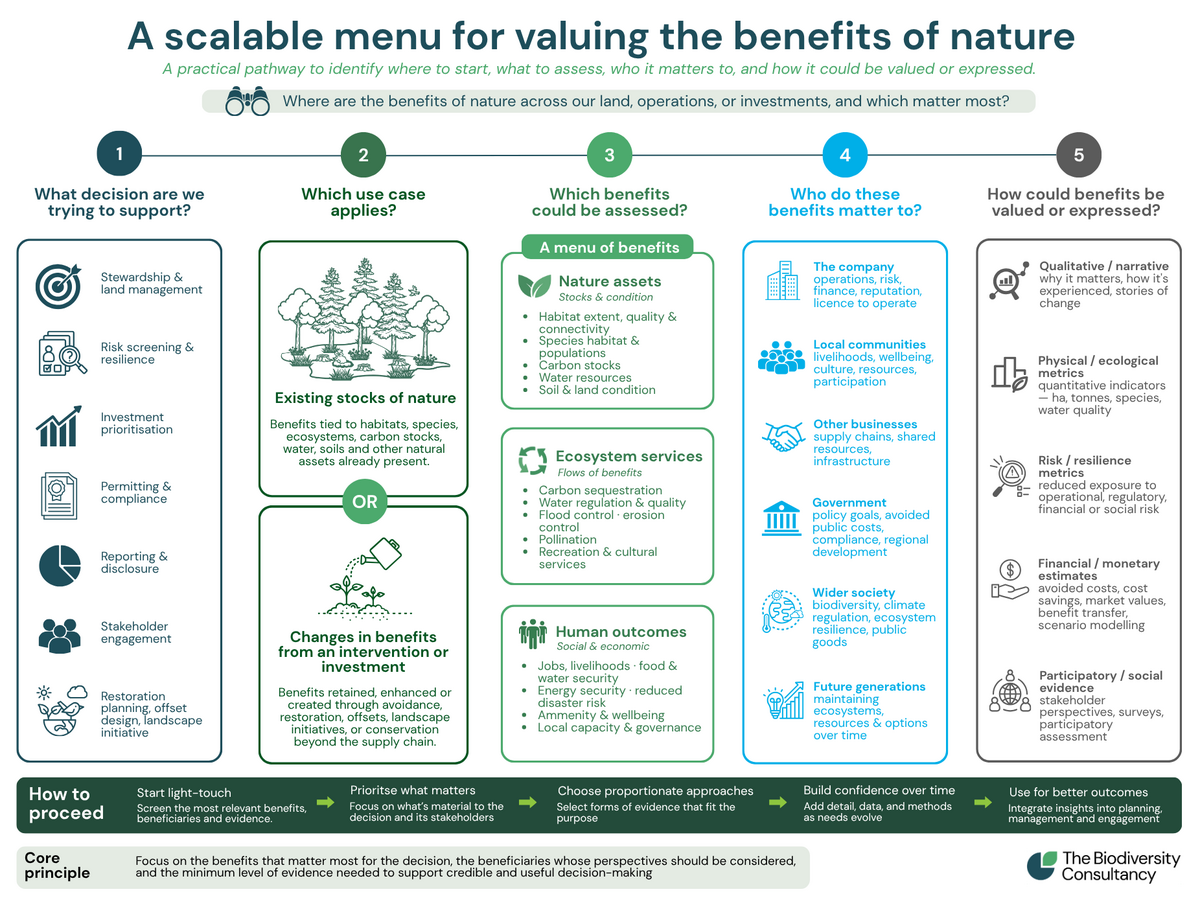
The figure below provides a practical menu for narrowing that question. It starts with the decision being supported, distinguishes between existing stocks of nature and changes in the benefits provided by nature, and then helps identify the relevant benefits, beneficiaries and forms of evidence.
Companies do not need to assess every possible benefit at once. The first step can be a light-touch review of relevant benefits and beneficiaries, with detail added where decisions require greater confidence or where findings point to a need for deeper analysis.
This might mean starting with a simple screen of nature assets, ecosystem services and human outcomes across a site or portfolio. It might then mean adding more detailed ecological metrics, risk and resilience analysis, financial or monetary estimates, scenario modelling or participatory assessment, depending on what the decision requires.
Please reach out to us to find out how we can support your nature valuation and decision-making needs.