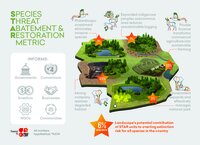
…STAR, the Species Threat Abatement and Restoration metric, gives businesses, financiers, investors and governments a practical and comparable tool to quantify how specific actions at specific locations can contribute to…
…Evaluating the LIFE metric: flexibility, use cases and value for biodiversity decision-making The Biodiversity Consultancy team are excited to have collaborated with the Conservation Science Group at the University of…
… identify the best approach to assess biodiversity impacts, including the use of widely recommended metrics such as the Species Threat Abatement and Restoration (STAR) metric, or developing a tailored approach…
… (eg habitat area and quality as indicators of a species’ abundance). 3. Convert the measures/counts/metrics into a fungible currency or currencies (ie to facilitate trade or exchange). Convert these counts and…
… and taking a quantitative approach are still desirable to ensure effective delivery. Currencies and metrics to demonstrate BES losses and gains exist but are still being refined and tested.18 BES target…
… organisations from diverse sectors, to establish scientifically credible, practical, and standardised metrics for tracking and measuring progress towards a Nature Positive outcome, defined as “having more nature…
… from governments, financial institutions and company policies (e.g. on which species, type of metrics, or definition of no net loss). Matching these up can be complicated and a one size fits all offset…
Research with University of Oxford study has determined that the widely used tools available to businesses for assessing their biodiversity impacts depend on broad assumptions and can have large
The decline of primate populations—especially those featured in the Primates in Peril: 2023–2025 report—has significant implications for biodiversity and the resilience of nature-dependent supply