
The IPBES Assessment: Setting a pathway for aligning business and nature
At one minute to midnight on Saturday 7th February, the deliberations at IPBES12 finally came to an end, and the next morning 150+ governments approved the body’s landmark report on the relationships between business and nature.
Over the course of five days in Manchester, the plenary of IPBES, the Intergovernmental Science Policy Platform on Biodiversity and Ecosystem Services, has been agreeing the wording of the summary for policymakers (SPM) of its Business and Biodiversity Assessment.
That assessment will inform how businesses and policymakers think about the impacts and dependencies that business has on nature. It will guide action to address nature risk and seize opportunities and help companies develop nature-positive business models.
Our Director for Science and Policy, Dr Laura Sonter, has been at the heart of the IPBES12 process, as one of the assessment’s Coordinating Lead Authors. She has been in Manchester for the plenary, taking part in the negotiations to agree the SPM’s final wording.
In a recent blog ahead of IPBES12, we explained what IPBES is, the thinking behind its latest assessment, and why it is important for business. Now that IPBES12 has concluded, Laura reflects on the key messages business should take from the assessment process and the SPM.
1. It is possible to align what’s profitable for business with what’s good for nature
Much of the narrative around nature and business has been framed in terms of negative impacts, and the short-term incentives that drive much business activity often conflict with longer-term imperatives to protect biodiversity and the natural world. However, the SPM argues that, by avoiding or reducing those risks, business can transform nature risk into opportunity, creating positive outcomes for both nature and the private sector. Equally, with the right enabling environment, it is possible to create incentives that align conservation, restoration and the sustainable use of biodiversity with profit and growth.
2. There is now global consensus: all businesses have a role to play in nature positive
The assessment is explicit that achieving the goals and targets of the Kunming–Montreal Global Biodiversity Framework (often referred to by business as a ‘nature-positive’ future) requires a whole-of-society approach. That includes businesses and financial institutions, alongside governments and civil society. While some companies clearly have a greater ability to drive change, for example through influence over global supply chains or operations in biodiversity-rich regions, the message is not that responsibility sits with a few sectors alone. Rather, every business has a responsibility to act, in ways that are informed by their impacts, dependencies and influence.
3. You don’t need perfect data to get started
A key and reassuring message is that businesses do not need perfect, or even extensive, biodiversity data to begin their nature journey. At the corporate level in particular, very little measurement is required before a company can set ambition and direction, develop strategy and policy, allocate resources and incentives, and put governance in place to drive action across operations, value chains, and portfolios. Strategies that are shaped through meaningful engagement with internal and external stakeholders can be particularly effective, even where data is incomplete.
Measurement becomes more important as decisions and actions move closer to operations and supply chains but, even then, action should not be delayed in pursuit of perfect information. Instead, the best available information can be used to get started, enabling learning by doing and improvements to measurement over time. Even imperfect information can improve existing performance and inform future decisions.
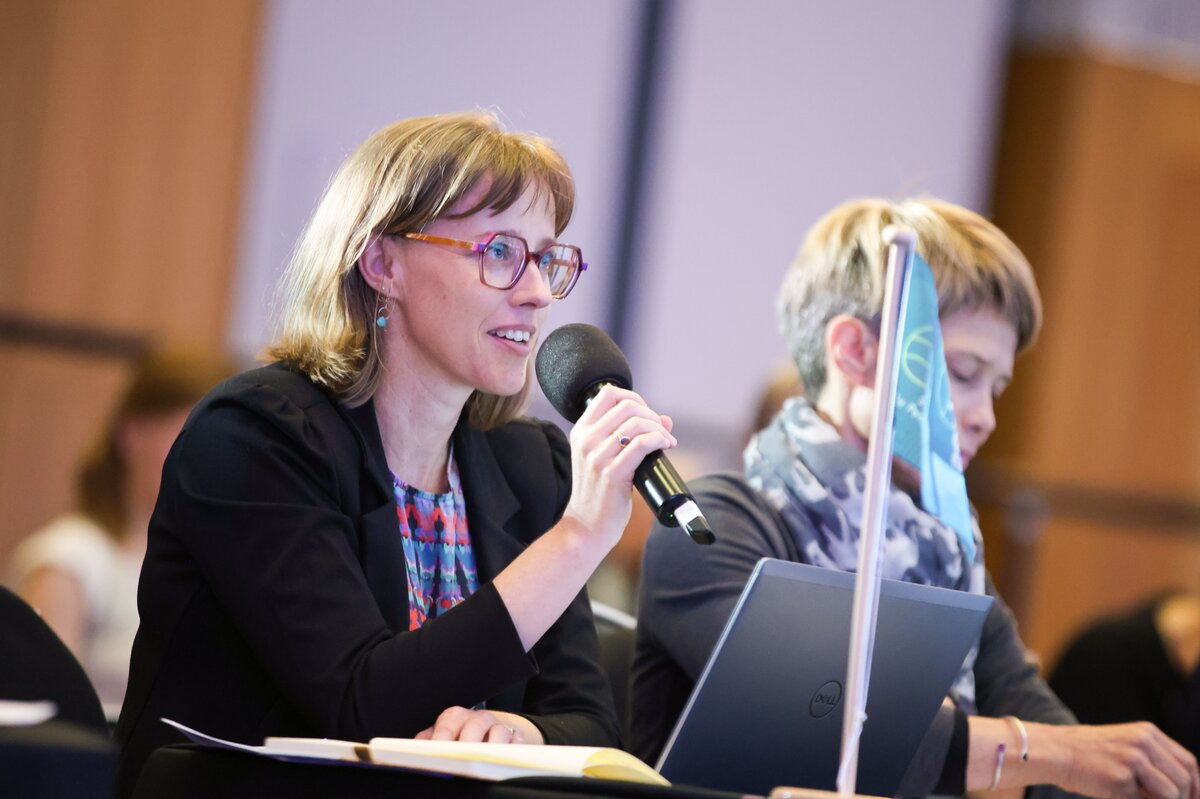
Laura Sonter speaking at the IPBES12 Plenary. Image by IISD/ENB | Anastasia Rodopoulou.
4. Collaboration and collective efforts are essential complements to individual corporate actions
The assessment is clear that businesses must address their own impacts and dependencies. Indeed, doing so will often directly benefit the company taking action, by unlocking efficiencies and reducing risks. However, transformative change will also depend on collective action to shape and create the enabling conditions for scaling business action.
Many of the most important drivers of biodiversity loss and the solutions to address them often sit beyond the control of any single company. Collective approaches are critical for changing the systems in which businesses operate and for enabling progress at the scale and pace required. These will include collaboration along and across supply chains, within landscapes and seascapes, and with peers, governments, NGOs, and other actors.
5. We have plenty of tools; the challenge is knowing which to use, when and why
There is already a vast and growing array of tools and methods to measure biodiversity and the benefits that nature provides to people, and the assessment notes that we do not need more methods. What we do need is better guidance on their effective use.
One of the most practically useful contributions of the SPM is the way it organises existing methods through clear typologies that link: decision-making levels (e.g., operations, value chains, portfolios); types of business decisions (e.g., screening, impact assessment, outcome evaluation); and the data requirements and limitations of different approaches. These distinctions matter. Methods that are useful for high-level screening may be inappropriate for measuring outcomes, and vice versa.
Businesses (and those advising them) really must focus less on ‘the best tool’ or a ‘universal metric’ and more on selecting tools and methods for measurement that are appropriate for the specific decision they are trying to inform.
6. Opportunities exist to address key knowledge gaps
The assessment also highlights the limits to current knowledge and methods. As more businesses and financial institutions engage with nature, there is a need for innovation in measurement, analysis and communication to support better decision-making. Three gaps stand out as particularly important:
- Measuring dependencies: methods for measuring impacts are more advanced than those for dependencies, yet dependencies are so often critical for building internal business cases and identifying nature-related risks and opportunities, especially for companies further down value chains.
- Translating nature into business risk and opportunity: better methods are needed to link impacts and dependencies to financial risk, including improved monetary valuation approaches and more robust short- and long-term scenarios (covering extreme events, long-term ecological change, and evolving regulation).
- Demonstrating outcomes and avoiding greenwashing: credible strategies require evidence of real biodiversity outcomes. This demands better ways to attribute outcomes to business actions, particularly where outcomes emerge at ecological scales influenced by many actors across value chains and regions.
Considerable work is underway across both academia and the private sector to develop the tools and methodologies to fill these knowledge gaps. Given the growing focus on nature and business, this presents opportunities for solutions providers in monitoring technologies and data and analytics.
What next for business?
The SPM provides an important framework to help businesses think about and respond to their nature dependencies, impacts, risks, and opportunities. We expect it to spur action among policymakers at various levels, while also providing businesses with a clearer and more coherent basis for decision-making and action.
At The Biodiversity Consultancy, we will use the SPM and the wider IPBES Business and Biodiversity Assessment to directly inform how we support clients — from setting ambition and governance, to prioritising actions across operations, value chains and portfolios, and selecting measurement approaches that are appropriate for specific business decisions. In practice, this means helping organisations move from high-level commitments to credible, decision-relevant strategies that demonstrate progress while improving data and methods over time.
We will also use the Assessment as a shared evidence base to strengthen our science-based collaboration with academic partners, NGOs and business-led initiatives.
We are also holding a webinar to discuss its outputs. Click here to register.
If you want to speak to any of our experts about IPBES’s work and its implications for business, contact Laura Sonter.
Image by IISD/ENB | Anastasia Rodopoulou.
Category: Insight
Where Business and Nature Thrive
Collaborate with us to deliver measurable nature impact.