A global approach for setting bat impact thresholds at wind farms
Deployment of wind energy at scale is essential for addressing climate change, however, as far as possible, to avoid unintended impacts on nature, this expansion should include biodiversity mitigation and enhancement actions.
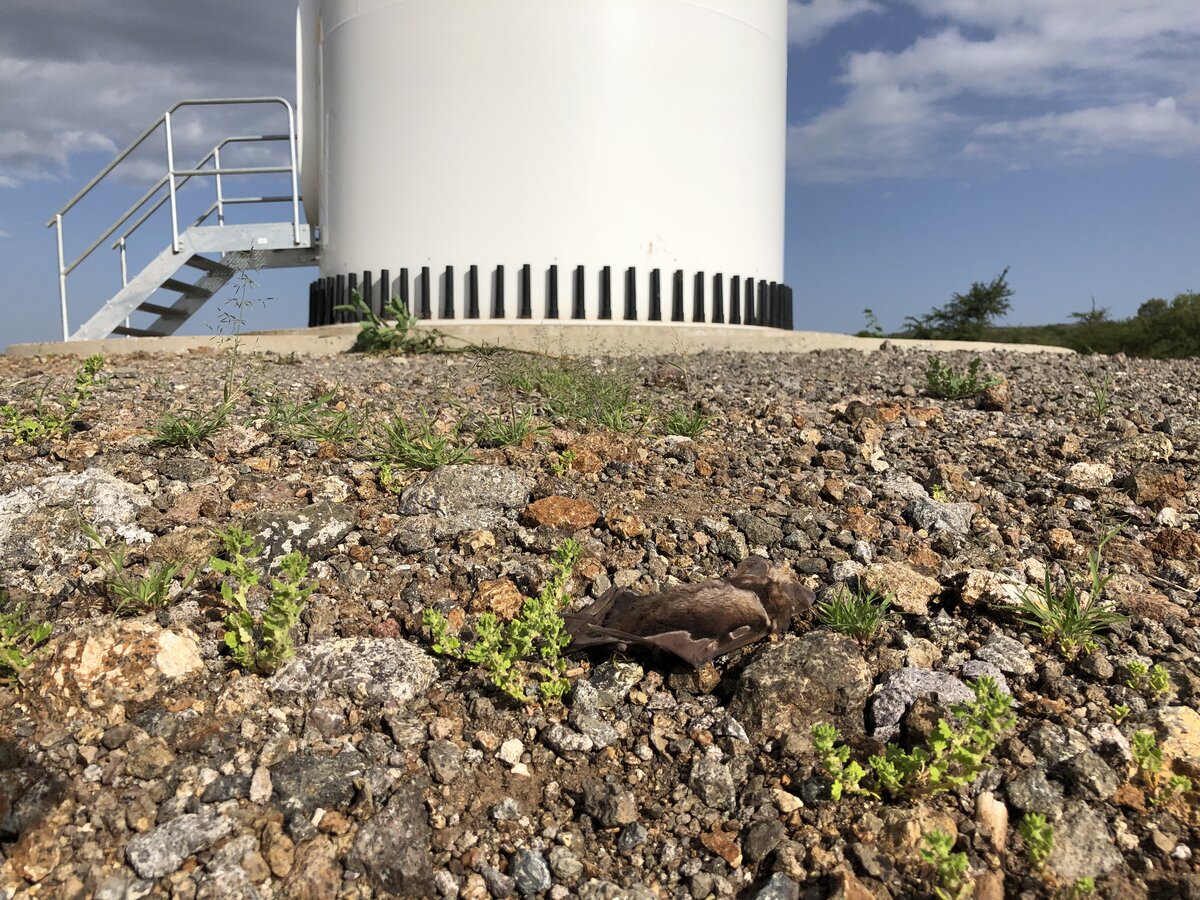
Bats are one of the species-groups most impacted by wind energy, through collision of bats with moving turbine blades. Bat fatalities have been recorded at all wind farms with robust monitoring, often in large numbers. However, the population-level effects of such impacts are more challenging to determine, as:
- Global population information for most bat species is lacking;
- Site-specific acoustic surveys cannot be used to estimate local population sizes; and,
- There is insufficient basic biological understanding to model most species’ populations.
This uncertainty becomes even more pronounced as wind energy projects expand globally into areas where bat communities are less well understood.
Due to this uncertainty, the level of sustainable impact (i.e. the level of impact that does not have a significant population effect) for bat species have been difficult to define, and the adoption of impact thresholds for bats has been inconsistent or non-existent across projects, despite the availability of proven mitigation technologies.
Proposing a global decision framework for reducing bat fatalities at wind energy facilities
To solve this issue, The Biodiversity Consultancy (TBC) has worked with partners over the last two years to develop a scientifically robust approach. This new paper proposes a method to set impact thresholds for bats at wind farms that can be applied to projects of any size, anywhere in the world.
To allow for broad applicability, the simplest model requires only the following inputs:
- The project footprint;
- The species present, or predicted to be present, in the project area; and,
- Their Red List status.
Site-specific survey information can then be used, where available, to refine the threshold values derived from default parameters. The paper also recommends initial curtailment parameters which a project should implement to not exceed the thresholds derived from using the tool, and an adaptive management approach using Post-Construction Fatality Monitoring to inform adjustment of the initial curtailment parameters.
How wind energy developers and regulators can implement this approach
For developers, this paper provides a defensible threshold-setting approach that is based on bat species’ biological attributes.
Thresholds can be first calculated as part of initial project feasibility, and then refined as site-specific information becomes available. The approach also allows for potential curtailment to be factored into energy yield assessments for any site envelope being considered. As threshold setting uses an area-based approach, developers also automatically understand their contribution to cumulative impacts without having to undertake any separate cumulative impact assessment process.
For lenders or regulatory bodies, this approach enables consistent and equitable threshold-setting across projects with a jurisdiction or portfolio – irrespective of their location, the level of understanding of bat presence or abundance, or development timing.
Lenders and regulars can also require the recommended levels of initial curtailment and adaptive management process to be included in project documents or permit conditions.
Please get in touch if you’d like to know more or discuss setting bat impact thresholds at your project or across your portfolio of sites.
The full paper, threshold setting excel tool and supplementary information can be accessed here.
This paper was a collaboration between The Biodiversity Consultancy (David Wilson), Bat Conservation International and Western EcoSystems Technology.
TBC provides expert support to both developers and lenders globally in the assessment and mitigation of biodiversity impacts from wind energy development.
Category: Publications
Where Business and Nature Thrive
Collaborate with us to deliver measurable nature impact.